
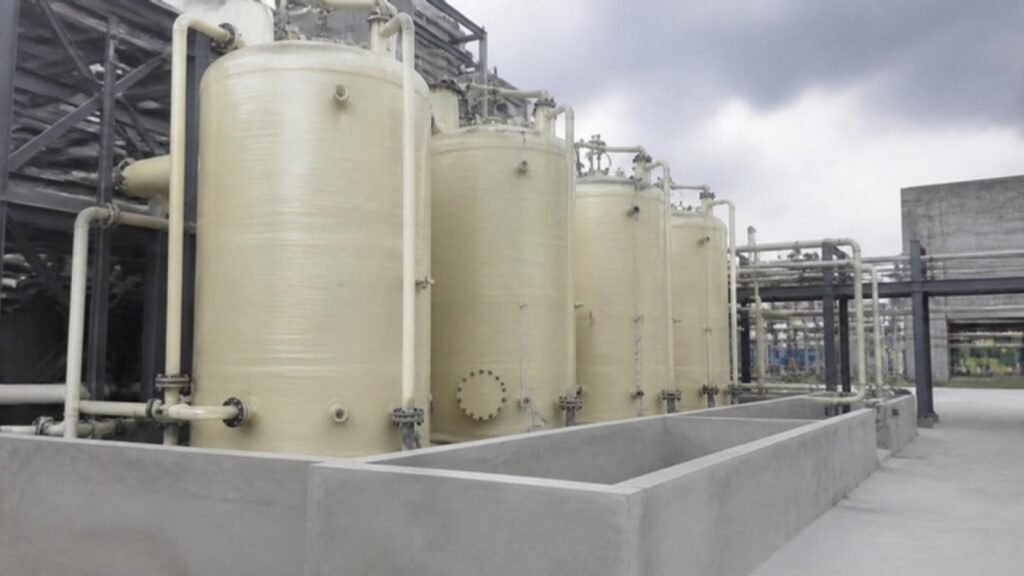
Sulphuric acid (H₂SO₄) is one of the most widely used industrial chemicals in Pakistan — in fertilizer production, battery manufacturing, textile processing, metal pickling, effluent treatment and chemical plants. Storing it safely depends above all on one thing: its concentration. The right tank material for 98% acid is completely different from the right material for 30% acid, and getting this wrong is a common and costly mistake.
Why Concentration Changes Everything
Sulphuric acid behaves very differently at different strengths:
- Concentrated acid (around 93–98%) is relatively mild to carbon steel, which forms a protective iron sulphate layer — but it is a powerful dehydrating agent that attacks most resins and plastics.
- Dilute and intermediate acid (below about 70–75%) is highly corrosive to carbon steel, which corrodes rapidly — but a correctly specified FRP tank resists it well.
So there is no single “best” material — it depends on the concentration and temperature you store.
Choosing the Material by Concentration
| Concentration | Typical material | Notes |
|---|---|---|
| Dilute to about 70% | FRP with vinyl ester resin | Corrosion-free, no iron contamination, large custom sizes |
| About 70–90% | Specialist alloys or linings | Very corrosive range — needs careful engineering |
| 93–98% (concentrated) | Carbon steel (commonly) or specialist alloys | FRP and most plastics are not suitable |
Our technical datasheet rates vinyl ester FRP as good for sulphuric acid up to 70% concentration at temperatures up to 50 °C. Always confirm the resin system for your exact concentration, temperature and any impurities.
Important: diluting concentrated sulphuric acid generates a lot of heat. Dilution tanks must be designed for the temperatures reached during mixing — and acid must always be added to water, never water to acid.
Why FRP for Dilute Sulphuric Acid?
- No corrosion: Carbon steel corrodes rapidly in dilute acid; FRP does not.
- Product purity: No iron pickup to discolour or contaminate the acid.
- Long life, low maintenance: No relining or repainting.
- Custom design: Vertical or horizontal tanks from 500 litres to 300,000 litres, diameters from 1.8 m to 8 m, with nozzles where you need them.
As with all chemical service, the corrosion barrier — a resin-rich inner liner with a surface veil — is what protects the structural laminate. See our resin selection guide.
Design Essentials for a Sulphuric Acid Tank
- Venting: Use a properly sized vent; sulphuric acid absorbs moisture from the air, so a desiccant breather is often used on concentrated acid tanks. Acid mist from vents can be treated with a fume scrubber.
- Bottom outlet and valves: Isolation valve close to the tank, with compatible pipework and valves for the concentration.
- Secondary containment: An acid-resistant bund sized for the full contents. FRP grating gives corrosion-proof access over bunds.
- Segregation: Keep sulphuric acid away from caustic soda, sodium hypochlorite and other incompatible chemicals, in separate bunds.
- Safety: Level indication, clear labelling, splash protection and an emergency shower and eyewash nearby.
Where Sulphuric Acid Tanks Are Used in Pakistan
- Fertilizer plants (phosphate and ammonium sulphate production)
- Lead-acid battery manufacturing (battery acid around 30–40%)
- Textile processing and dyeing
- Steel pickling and metal finishing
- Effluent treatment (pH control)
See our chemical & fertilizer industry solutions and our guide to HCl storage tanks.
Frequently Asked Questions
Can sulphuric acid be stored in an FRP tank?
Yes, for dilute and intermediate concentrations — up to about 70% with vinyl ester resin. Concentrated 93–98% acid should not be stored in FRP.
Can sulphuric acid be stored in plastic?
Some plastics handle dilute acid, but concentrated sulphuric acid attacks most plastics. Material must always be chosen for the specific concentration and temperature.
What material is used for 98% sulphuric acid storage?
Carbon steel is commonly used for concentrated acid at ambient temperature, with specialist alloys where higher purity or temperatures are involved.
What tank do I need for battery acid?
Battery-grade acid (around 30–40%) is well within the range of vinyl ester FRP tanks.
Get a Quote from Global Fiberglass
Global Fiberglass Company has been manufacturing FRP/GRP tanks, pipes, chemical plant equipment and infrastructure products in Faisalabad since 1978, with delivery across Pakistan. Share your requirement — the product, size, chemical or application, and site location — and our engineers will recommend the right design.
- Phone / WhatsApp: +92-320-640-7732
- Email: sale@globalfiberglass.pk
- Online: Request a free quote or download our technical datasheets