
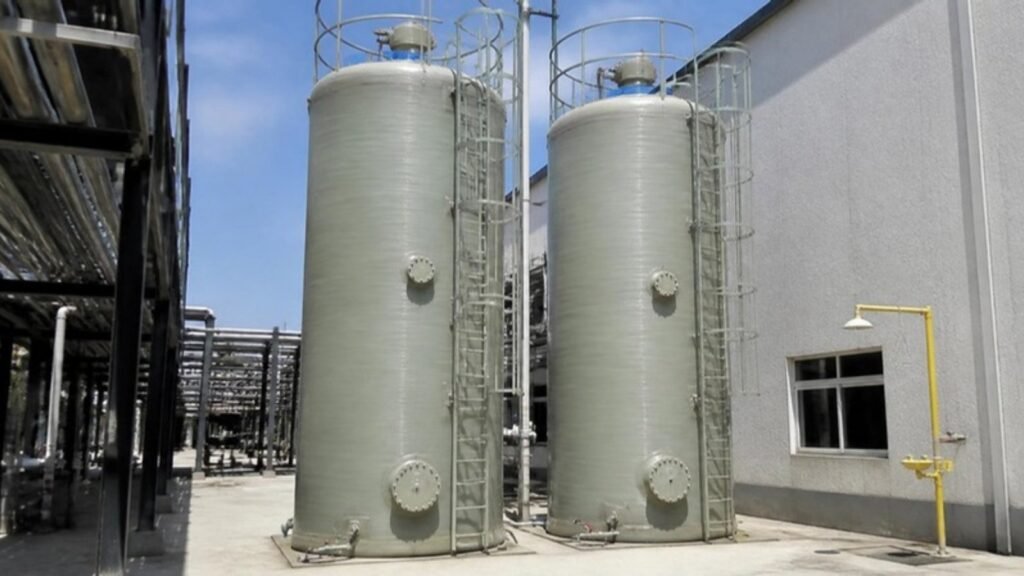
Caustic soda (sodium hydroxide, NaOH) is used across Pakistani industry — in textile mercerising and scouring, soap and detergent making, pulp and paper, and chemical manufacturing. It is usually delivered as a 32% or 50% solution, and storing it safely depends on choosing the right tank material, the right resin and a few key design details.
Why Caustic Soda Needs Careful Storage
- Highly alkaline: Concentrated NaOH attacks aluminium, zinc and galvanised steel, and degrades many ordinary polyester resins.
- Crystallises when cold: 50% caustic soda starts to freeze at around 12 °C, so tanks and lines may need heating or insulation in winter in the north of Pakistan.
- Heat of dilution: Diluting strong caustic releases significant heat, so mixing tanks must be rated for higher temperatures.
- Serious health hazard: Caustic causes severe burns to skin and eyes, so leaks and splashes must be prevented.
Tank Material Options for Caustic Soda
| Material | Notes |
|---|---|
| Carbon steel | Commonly used at moderate temperatures, but iron pickup can discolour the product and stress corrosion cracking is a risk at higher temperatures. |
| Stainless steel | Good resistance but expensive, particularly for large tanks. |
| Polyethylene | Suitable for smaller tanks at ambient temperature. |
| FRP (vinyl ester) | Corrosion-free, no product contamination, large custom sizes, light weight — and the same tank technology can serve your acid and hypochlorite tanks too. |
Choosing the Resin: Vinyl Ester Is Essential
Not every fiberglass tank can hold caustic soda. Standard orthophthalic and many isophthalic resins are attacked by strong alkalis. Our technical datasheet rates vinyl ester resin as excellent for caustic soda up to 50% concentration at up to 60 °C.
The corrosion barrier is especially important in caustic service. Glass fibres are attacked by alkalis, so the inner liner must keep the caustic away from them. Synthetic (polyester) surface veils are generally preferred over glass veils for alkaline service — ask your manufacturer which veil they use. See our resin selection guide for more detail.
Design Requirements for a Caustic Soda Tank
- Temperature: Specify the maximum temperature, including any heating, dilution or hot-fill conditions.
- Heating and insulation: For 50% caustic in cold regions, consider external heating and insulation to prevent crystallisation.
- Venting: Fit a vent with a moisture trap to limit CO₂ absorption, which forms sodium carbonate in the tank.
- Nozzles: Bottom outlet with an isolation valve close to the tank wall; FRP, PVC+FRP or compatible plastic pipework.
- Secondary containment: A bund sized for the full contents, separate from acid storage.
- Safety: Level indication, clear labelling, and an emergency eyewash and shower close to the tank.
Typical Applications in Pakistan
- Textile mills: mercerising, scouring and dye-house chemical stores
- Soap, detergent and chemical manufacturing
- Pulp and paper mills
- Food and beverage CIP (clean-in-place) systems and effluent pH correction
See our chemical & fertilizer industry solutions and our guides to HCl storage tanks and sodium hypochlorite tanks.
Frequently Asked Questions
Can caustic soda be stored in a fiberglass tank?
Yes — if the tank is built with vinyl ester resin and a corrosion barrier designed for alkaline service. A general-purpose fiberglass tank is not suitable.
What is the best material for a 50% caustic soda tank?
For most industrial storage, vinyl ester FRP or carbon steel, depending on temperature, purity requirements and size. FRP avoids iron contamination and corrosion entirely.
Can the same tank store caustic soda and acid?
No. Tanks should be dedicated to one chemical, and acid and alkali tanks should be in separate bunded areas.
What sizes do you make?
From 500 litres to 300,000 litres, vertical or horizontal, in diameters from 1.8 m to 8 m.
Get a Quote from Global Fiberglass
Global Fiberglass Company has been manufacturing FRP/GRP tanks, pipes, chemical plant equipment and infrastructure products in Faisalabad since 1978, with delivery across Pakistan. Share your requirement — the product, size, chemical or application, and site location — and our engineers will recommend the right design.
- Phone / WhatsApp: +92-320-640-7732
- Email: sale@globalfiberglass.pk
- Online: Request a free quote or download our technical datasheets