
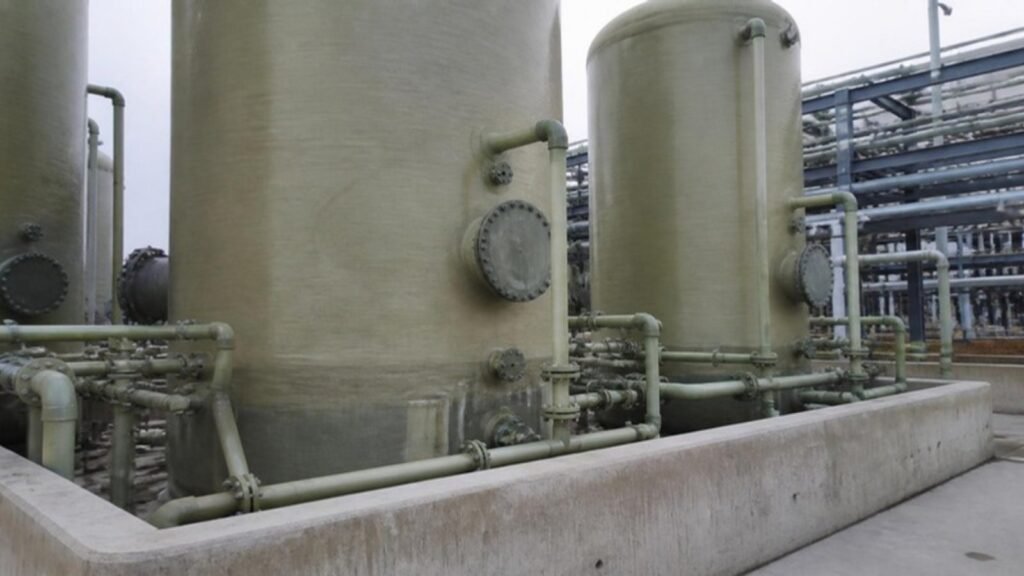
Hydrochloric acid (HCl) is one of the most widely used chemicals in Pakistani industry — in textile processing, water treatment, steel pickling, chemical manufacturing and fertilizer plants. It is also one of the hardest liquids to store. Carbon steel corrodes quickly, stainless steel is attacked by chlorides, and rubber-lined steel needs regular relining.
That is why FRP (fiberglass reinforced plastic) has become the standard material for HCl storage tanks. This guide explains why, which resin to choose, and what else your HCl system needs.
Why FRP Is the Preferred Material for HCl Tanks
- No corrosion: A correctly specified FRP laminate is not attacked by hydrochloric acid, so there is no rust, pitting or wall loss.
- Long service life: With the right resin and corrosion barrier, FRP HCl tanks commonly serve for decades.
- Lightweight: FRP is far lighter than steel, which reduces foundation, transport and installation costs.
- Low maintenance: No painting, cathodic protection or periodic relining.
- Custom sizes: Tanks can be built in almost any diameter, height and orientation, with nozzles exactly where you need them.
Choosing the Right Resin for Hydrochloric Acid
The resin, not the glass, is what resists the acid. For HCl and related chemical service we recommend:
| Chemical | Concentration | Max. temperature | Resin | Rating |
|---|---|---|---|---|
| Hydrochloric acid (HCl) | Up to 35% | 60 °C | Vinyl ester / Isophthalic | Excellent |
| Sulphuric acid (H₂SO₄) | Up to 70% | 50 °C | Vinyl ester | Good |
| Caustic soda (NaOH) | Up to 50% | 60 °C | Vinyl ester | Excellent |
| Sodium hypochlorite (NaOCl) | Up to 15% | 40 °C | Isophthalic / Vinyl ester | Excellent |
Source: Global Fiberglass technical datasheet. Always confirm the resin for your exact concentration, temperature and any impurities in the acid.
Commercial hydrochloric acid is usually supplied at around 30–33%, which sits within vinyl ester and isophthalic limits at ambient temperature. For a detailed comparison of the two resins, see how to pick the right resin for FRP tanks.
The Corrosion Barrier: The Most Important Layer
If acid reaches the glass fibres, it can travel along them and weaken the whole laminate. A proper HCl tank therefore has a chemical-resistant inner liner: a resin-rich surface veil, backed by layers of chopped strand mat, before the structural wall begins. Ask your manufacturer to state the liner construction and thickness in the quotation.
Design Details That Matter for HCl Tanks
Fume control
Concentrated HCl gives off corrosive fumes that damage nearby steelwork and are a health hazard. Tank vents should be connected to a fume scrubber or vapour absorber. We build complete FRP HCl vapour absorber systems — packed towers, FRP centrifugal blowers, spray headers and pipework.
Nozzles and pipework
Use FRP or PVC+FRP composite piping, and diaphragm or PVC/FRP valves, so the whole line resists the acid. Our FRP nozzles range from ½” to 14″ and can be flanged or threaded.
Secondary containment
Place acid tanks inside a bunded area sized to hold the tank contents in case of a leak, with an acid-resistant floor. FRP grating makes safe, corrosion-proof walkways over bunds.
Level indication and access
Sight glasses, level indicators, a 500 mm manhole and a corrosion-resistant ladder make daily operation safer.
New FRP Tank or FRP-Lined Steel Tank?
If you already have sound mild steel tanks, FRP lining can convert them for HCl service at lower cost than replacement. We line MS tanks with 4–10 mm of hand-laid FRP, for capacities up to 300 tons. For new installations, an all-FRP tank is usually the better long-term choice because there is no steel to corrode if the lining is ever damaged.
Frequently Asked Questions
What is the best material for a hydrochloric acid storage tank?
For most industrial HCl storage up to about 35% concentration at ambient temperature, FRP with a vinyl ester or isophthalic corrosion barrier is the most practical and economical choice.
Can I store HCl in a stainless steel tank?
No. Hydrochloric acid attacks stainless steel, causing pitting and failure.
Can the same tank be used for HCl and caustic soda?
A vinyl ester tank can resist both, but a tank should never be switched between acid and alkali without thorough cleaning, and a dedicated tank for each chemical is strongly recommended.
What size HCl tanks can you build?
From 500 litres up to 300,000 litres, in diameters from 1.8 m to 8 m, vertical or horizontal. See our chemical & fertilizer industry solutions.
Get a Quote from Global Fiberglass
Global Fiberglass Company has been manufacturing FRP/GRP tanks, pipes and chemical plant equipment in Faisalabad since 1978, with delivery across Pakistan. Send us the capacity you need, the liquid you will store, its temperature and your site location, and our engineers will recommend the right design and resin system.
- Phone / WhatsApp: +92-320-640-7732
- Email: sale@globalfiberglass.pk
- Online: Request a free quote or download our technical datasheets