
Pakistan has many workshops that can mould a fiberglass tank, but far fewer FRP tank manufacturers that can engineer a tank for acids, caustic, hypochlorite or hot process water and stand behind it for decades. The wrong choice usually becomes clear only after the tank starts leaking — so it pays to ask the right questions before you place the order.
Here are ten questions we recommend every buyer asks, whether they buy from us or from anyone else.
1. How long have you been manufacturing FRP tanks?
Composite fabrication is a craft learned over many projects. Ask how long the company has been in business and for examples of tanks that are still in service after 10–15 years. Global Fiberglass has been manufacturing FRP/GRP products in Faisalabad since 1978.
2. Which resin will you use — and why?
A serious manufacturer will ask what you are storing before quoting. Orthophthalic resin is fine for water; chemicals need isophthalic or vinyl ester. If a supplier quotes an acid tank without asking about concentration and temperature, walk away. Our resin selection guide explains the options.
3. Is there a corrosion barrier, and how thick is it?
In chemical service, the inner layer does the real work. A proper corrosion barrier uses a resin-rich surface veil backed by chopped strand mat, so the chemical never reaches the structural glass. Ask for the barrier construction in writing.
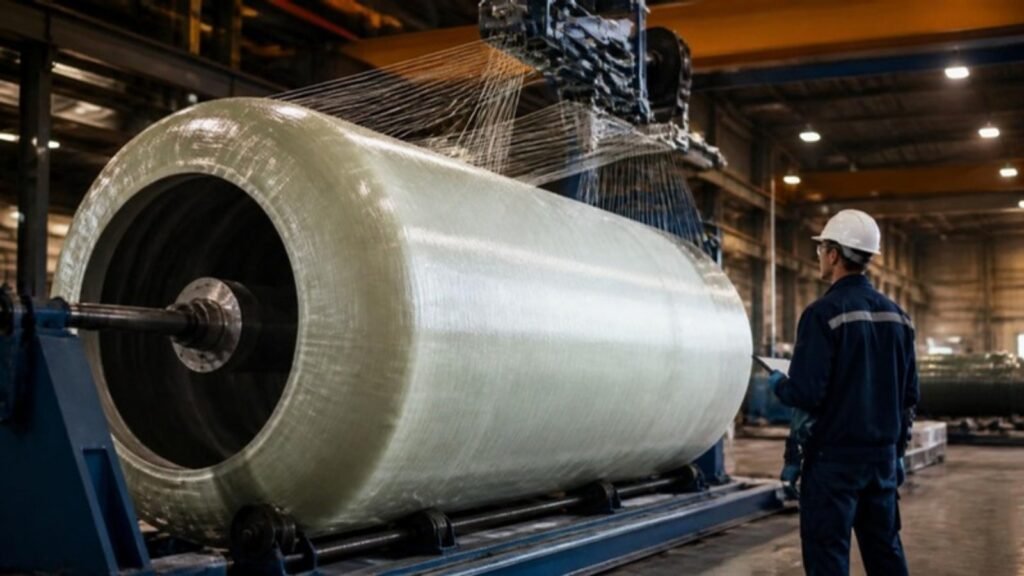
4. Hand lay-up or filament winding?
Both methods have their place. Filament winding gives consistent glass content and hoop strength in cylindrical shells; hand lay-up is used for dish ends, nozzles and custom shapes. Good manufacturers use each where it fits best.
5. What sizes can you actually build?
Mould sizes limit what a factory can produce. Ask for the maximum diameter and capacity they have delivered. We work with diameters from 1.8 m up to 8 m and capacities from 500 litres to 300,000 litres, and also build road transport tanks up to 30,000 litres.
6. Which standards do you design to?
Recognised standards give you something to check the product against. Ask which ones apply to your tank or pipework — for example BS 6464, ASTM D2996/D2997, ISO 14692 or AWWA C950 for different product types.
7. What quality checks do you perform?
Ask about Barcol hardness testing of the cure, wall-thickness checks, visual inspection of the liner and hydrostatic leak testing before dispatch. Our article on quality control of FRP tanks covers what a complete QC process looks like.
8. Can you supply the complete system?
A tank rarely works alone. Being able to source FRP pipes, fittings, fume scrubbers, blowers and gratings from the same manufacturer saves coordination and ensures chemical compatibility across the whole system.
9. Do you deliver and install?
Large FRP tanks must be lifted and set down correctly to avoid damage. Check whether the price includes transport to your city, unloading, installation and on-site testing.
10. What happens after installation?
Ask about the warranty, spare parts, and whether the manufacturer can inspect and repair the tank later. A local manufacturer with a long track record is much easier to reach than a one-time supplier.
Red Flags to Watch For
- A quote that doesn’t mention resin type or wall thickness
- No questions asked about the chemical, concentration or temperature
- “One tank fits all” pricing for water and acid service
- No leak test or inspection before delivery
- No references from industrial customers
Frequently Asked Questions
Where are FRP tank manufacturers located in Pakistan?
Most industrial FRP manufacturing is concentrated in the Punjab and Karachi industrial belts. Global Fiberglass is based in Faisalabad and supplies customers nationwide.
Can an FRP manufacturer line my existing steel tank?
Yes. FRP lining of mild steel tanks is a cost-effective option for HCl, hypochlorite and caustic service. We line MS tanks with 4–10 mm FRP, for capacities up to 300 tons.
What industries use FRP tanks?
Chemical and fertilizer plants, textile mills, water and wastewater treatment, power generation, mining and food processing all rely on FRP tanks. See our chemical & fertilizer industry solutions.
Get a Quote from Global Fiberglass
Global Fiberglass Company has been manufacturing FRP/GRP tanks, pipes and chemical plant equipment in Faisalabad since 1978, with delivery across Pakistan. Send us the capacity you need, the liquid you will store, its temperature and your site location, and our engineers will recommend the right design and resin system.
- Phone / WhatsApp: +92-320-640-7732
- Email: sale@globalfiberglass.pk
- Online: Request a free quote or download our technical datasheets