
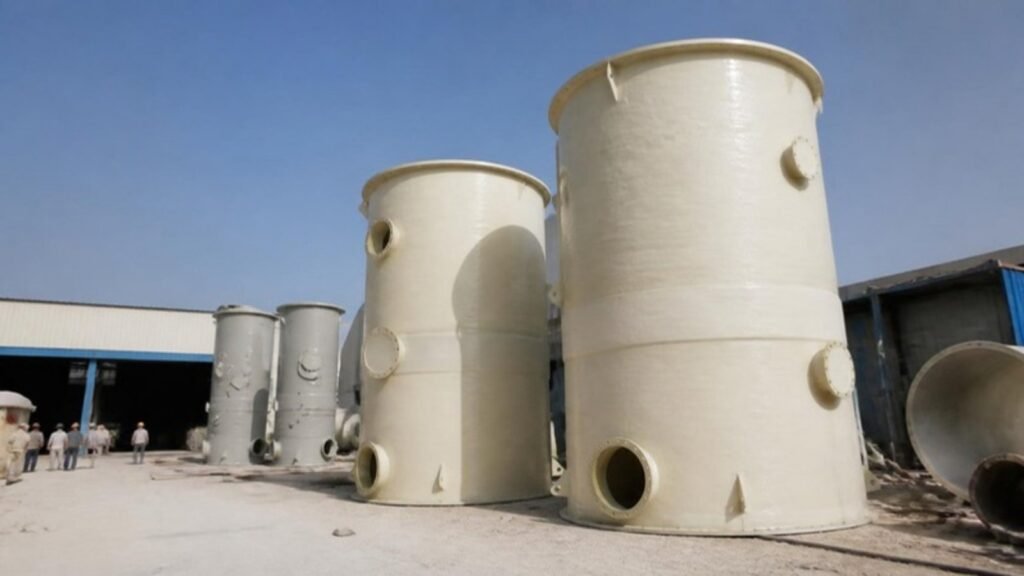
“What is the price of a fiberglass tank?” is the first question almost every buyer asks us. The honest answer is that two tanks with the same capacity can have very different prices, because the cost of an FRP (fiberglass reinforced plastic) or GRP tank depends far more on what it will store and how it is built than on its size alone.
This guide explains the factors that decide fiberglass tank prices in Pakistan, so you can compare quotations properly and avoid paying for a cheap tank that fails in two years.
Household Water Tanks vs Industrial FRP Tanks
When you search for “fiberglass water tank price in Pakistan”, most results show small rooftop tanks for homes. These are mass-produced in a few standard sizes, usually with general-purpose resin, and are priced like a consumer product.
Industrial FRP tanks are different. They are engineered for a specific liquid, temperature and site, and are often built to order. A 20,000-litre tank for hydrochloric acid in a textile mill needs a corrosion barrier, a thicker wall and a chemical-grade resin — none of which a household water tank has. Comparing the two on price per litre is misleading.
7 Factors That Decide the Price of an FRP Tank
1. Capacity and diameter
Bigger tanks need more resin and glass, so capacity is the starting point. Diameter matters too: a manufacturer that already owns a mold in the diameter you need can build faster and cheaper than one that has to make a new mold. At Global Fiberglass we have standard molds of 1.8, 2.0, 2.5, 3.0, 6.0 and 8.0 metres, covering capacities from 500 litres up to 300,000 litres.
2. What the tank will store
This is the single biggest cost factor. Drinking water can be stored in a tank made with orthophthalic or food-grade resin. Acids, caustic soda and sodium hypochlorite need isophthalic or vinyl ester resin, which costs considerably more. Read our resin selection guide to see which resin suits your chemical.
3. Temperature
Every resin has a temperature limit. A tank storing hot process liquid needs a higher-grade resin and sometimes a thicker laminate. Always tell your supplier the maximum operating temperature, not just the normal one.
4. Wall thickness and pressure
Most storage tanks work at atmospheric pressure, but some processes need pressurised vessels. Our tank walls range from 6 mm to 25 mm and dish ends from 8 mm to 30 mm, depending on diameter and pressure. More thickness means more material — and a longer service life.
5. Manufacturing method
Tanks are made either by hand lay-up or by filament winding. Filament-wound shells have consistent glass content and strength, which is why they are preferred for large and chemical tanks. A lower quote sometimes means a thinner hand-laid wall with less glass.
6. Orientation, supports and fittings
Vertical, horizontal and underground tanks all need different supports — flat base, saddles, pedestals or legs. Nozzles (½” to 14″), manholes, sight glasses, ladders, vents and level indicators each add to the price. Get these listed in the quotation so you are comparing like with like.
7. Delivery and installation
Large tanks are wide loads. Transport distance, road access and whether the tank is installed and tested on site all affect the final cost.
Why the Cheapest Quote Often Costs More
An FRP tank that is built with the wrong resin or without a proper corrosion barrier may look identical on delivery day. The difference shows up months later as blistering, softening or leaks — and then you pay for the chemical loss, the downtime and a replacement tank. A correctly specified FRP tank, on the other hand, can serve for decades with very little maintenance, which is why FRP usually works out cheaper over its life than lined steel.
What to Include When You Ask for a Price
To get an accurate quotation quickly, send your supplier:
- Required capacity (litres or m³) and any size limits on site
- The liquid to be stored and its concentration
- Minimum and maximum operating temperature
- Vertical, horizontal or underground installation
- Nozzles, manholes and accessories you need
- Delivery city and whether installation is required
Not sure whether you need FRP or GRP? Read FRP vs GRP industrial storage tanks — in practice the two terms describe the same material.
Frequently Asked Questions
Is a fiberglass tank more expensive than a plastic (polyethylene) tank?
For small household tanks, polyethylene is usually cheaper. For large capacities, high temperatures or aggressive chemicals, FRP is often the only practical option and is more economical over its lifetime.
Is an FRP tank cheaper than a steel tank?
The purchase price can be similar to a rubber-lined or coated steel tank, but FRP does not rust, needs no repainting or relining, and lasts much longer in corrosive service.
How long does an FRP tank last?
A properly designed FRP tank with the right resin and corrosion barrier typically serves for 20 years or more. Quality control during manufacture makes a big difference — see our guide to quality control of FRP tanks.
Do you deliver outside Faisalabad?
Yes. We supply FRP tanks to industries across Pakistan, including Karachi and Lahore.
Get a Quote from Global Fiberglass
Global Fiberglass Company has been manufacturing FRP/GRP tanks, pipes and chemical plant equipment in Faisalabad since 1978, with delivery across Pakistan. Send us the capacity you need, the liquid you will store, its temperature and your site location, and our engineers will recommend the right design and resin system.
- Phone / WhatsApp: +92-320-640-7732
- Email: sale@globalfiberglass.pk
- Online: Request a free quote or download our technical datasheets