
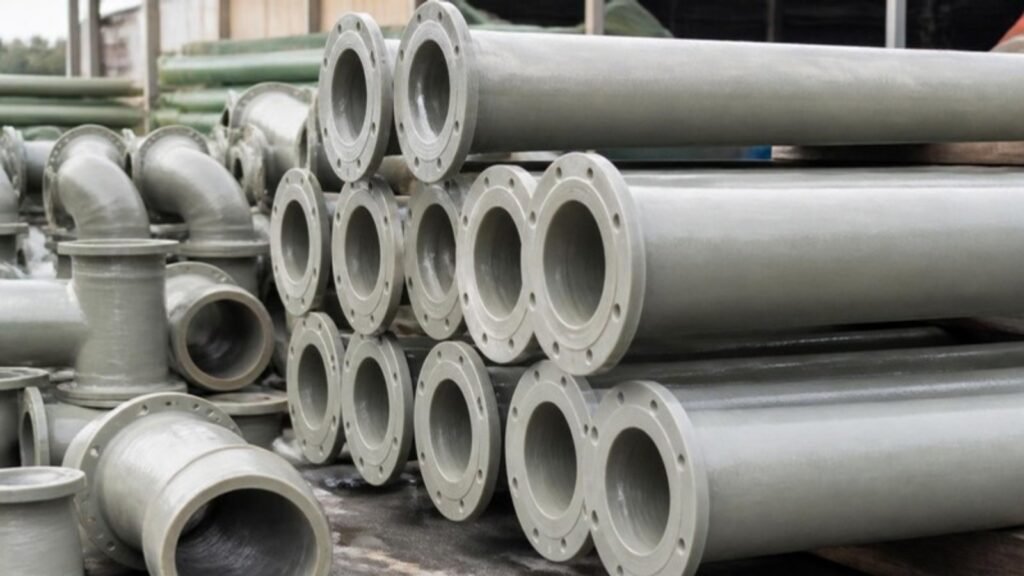
GRP (glass reinforced plastic) and FRP (fiberglass reinforced plastic) pipes are the same family of composite pipe. Across Pakistan they are replacing steel, cast iron and even stainless steel wherever pipelines carry corrosive liquids, saline water or chemical fumes. This guide explains the sizes and pressure ratings available, where GRP pipe makes sense, and how it compares with the alternatives.
What Is a GRP / FRP Pipe?
A GRP pipe is built from glass fibres bonded in a thermosetting resin. The inner surface is a resin-rich liner that resists chemicals and gives a smooth bore; the structural wall is made by filament winding or hand lay-up to carry pressure and external loads. Because the resin can be chosen for the fluid — isophthalic polyester, vinyl ester or epoxy — the same technology serves water, acids, alkalis and brine.
Global Fiberglass FRP Pipe Specifications
| Parameter | Range |
|---|---|
| Pipe sizes | 1″ – 14″ |
| Pipe length | Up to 6,000 mm |
| Wall thickness | 4 – 20 mm |
| Pressure rating | Up to 10 bar |
| End types | Flanged / bell & spigot |
| Flange ratings | PN6 / PN10 / PN16 |
| Fittings | 45° & 90° elbows, equal & reducing tees, concentric & eccentric reducers, end caps |
Full details are in our technical datasheets. Relevant standards for composite pipe include ASTM D2996, ASTM D2997, ISO 14692 and AWWA C950.
PVC + FRP Composite Pipe
For some chemical lines we reinforce a uPVC or CPVC core with a 2–8 mm FRP overwrap. The plastic core provides chemical resistance while the FRP adds strength, stiffness and impact resistance. These pipes (¾” to 12″, up to 70 °C) are widely used for HCl process headers, hypochlorite and brine lines.
Where GRP Pipes Are Used in Pakistan
- Chemical and fertilizer plants: acid, caustic and hypochlorite transfer lines
- Textile mills: dye-house effluent and chemical dosing lines
- Water and wastewater: treated water, sewage and effluent pipelines
- Power plants: cooling water intake and outfall lines
- Mining and mineral processing: slurry and process water lines
- Fume extraction: ducting from scrubbers and FRP blowers
See our FRP piping, pumps & blowers solutions for complete systems.
GRP Pipe vs Steel, HDPE and PVC
| GRP / FRP | Carbon steel | HDPE / PVC | |
|---|---|---|---|
| Corrosion resistance | Excellent (resin chosen for the fluid) | Poor without lining | Good for many chemicals |
| Weight | Light | Heavy | Very light |
| Stiffness & temperature | High stiffness, good temperature range | Very high | Softens at lower temperatures |
| Maintenance | Very low | Painting, lining, replacement | Low |
| Custom fittings | Easily fabricated | Welded | Limited in large sizes |
In short: choose GRP where you need corrosion resistance and stiffness or higher temperatures — the combination that plastic pipe alone struggles with and steel cannot provide without expensive lining.
Installation Tips
- Support GRP pipe at the spacing recommended by the manufacturer; it is lighter but less stiff than steel.
- Allow for thermal expansion on long runs and hot lines.
- Avoid point loads and over-tightening flange bolts — use the specified torque and gaskets.
- Protect exposed pipes from mechanical impact in busy plant areas.
Frequently Asked Questions
What is the difference between GRP and FRP pipe?
None in practice — both describe glass-fibre composite pipe. “GRP” is more common in the UK and Middle East, “FRP” in Pakistan and Asia. Read more in FRP vs GRP explained.
What pressure can FRP pipe handle?
Our standard FRP pipes are rated up to 10 bar, with flanges from PN6 to PN16. Higher ratings can be designed on request.
Can you make custom fittings and headers?
Yes. Elbows, tees, reducers, flanges and complete process headers are fabricated in-house to your drawings.
How long do GRP pipes last?
Correctly specified and installed GRP pipelines typically last several decades because they do not corrode.
Get a Quote from Global Fiberglass
Global Fiberglass Company has been manufacturing FRP/GRP tanks, pipes and chemical plant equipment in Faisalabad since 1978, with delivery across Pakistan. Send us the capacity you need, the liquid you will store, its temperature and your site location, and our engineers will recommend the right design and resin system.
- Phone / WhatsApp: +92-320-640-7732
- Email: sale@globalfiberglass.pk
- Online: Request a free quote or download our technical datasheets