
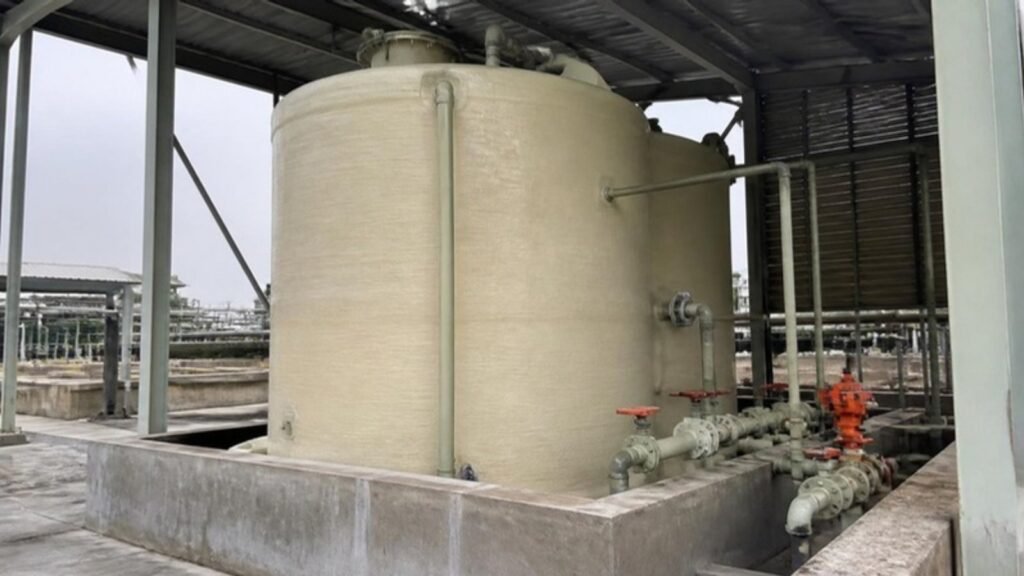
Sodium hypochlorite (NaOCl) — the bleach used for disinfection, textile bleaching and cleaning — is one of the trickiest chemicals to store. It attacks most metals, breaks down with heat and sunlight, and releases chlorine if it is contaminated or mixed with acids. Choosing the wrong tank material leads to leaks, discoloured product and rapid loss of strength.
This guide covers the best storage tank material for sodium hypochlorite, how to choose the resin, and the design details that keep a hypo tank safe and long-lasting.
Why Sodium Hypochlorite Is Hard to Store
- Highly corrosive to metals: Carbon steel and even stainless steel are attacked, and metal ions speed up decomposition of the hypochlorite itself.
- Oxidising: It degrades many plastics and rubbers over time.
- Temperature-sensitive: Strength drops faster as temperature rises — a real issue in Pakistani summers.
- Gas release: Contact with acids releases chlorine gas, so storage areas must be well separated from acid tanks.
Best Material for a Sodium Hypochlorite Storage Tank
For industrial storage, the two main options are polyethylene and FRP.
| FRP (fiberglass) | Polyethylene | |
|---|---|---|
| Sizes | Small to very large, custom shapes | Limited to moulded sizes |
| Stiffness and temperature | Rigid, holds shape in heat | Softens and creeps in high temperatures |
| Nozzles and fittings | Built exactly where required | Limited options |
| Chemical resistance | Excellent with the correct resin and liner | Good |
For anything beyond small day-tanks, a properly built FRP tank is usually the more durable choice.
Choosing the Resin
According to our technical datasheet, isophthalic polyester and vinyl ester resins both give excellent resistance to sodium hypochlorite up to 15% concentration at temperatures up to 40 °C. Vinyl ester is preferred where the tank will see higher temperatures, stronger solutions or long service life requirements.
Just as important as the resin is the corrosion barrier — a resin-rich inner liner with a surface veil that keeps the hypochlorite away from the structural glass. Hypochlorite is particularly unforgiving of a poorly cured or thin liner, so ask your supplier how the liner is built and cured. Read more in our resin selection guide.
Design Tips for Hypo Tanks
- Keep it cool and shaded: Place tanks indoors or under a shade, and use light-coloured or UV-protected exteriors to slow decomposition.
- Vent properly: Hypochlorite releases gases as it breaks down. Fit an adequately sized vent, routed away from people and metal structures — or connected to a fume scrubber.
- Use compatible pipework and valves: FRP, PVC+FRP or suitable plastic piping and valves — never ordinary steel.
- Separate from acids: Store away from hydrochloric or sulphuric acid tanks, with separate bunds, to prevent accidental mixing.
- Secondary containment: A bund sized for the full tank contents, with a chemical-resistant floor.
- Don’t over-size: Hypochlorite loses strength in storage, so size the tank for your delivery frequency rather than for months of stock.
Where Hypo Tanks Are Used in Pakistan
- Sodium hypochlorite manufacturing and chlor-alkali plants
- Textile bleaching in dyeing and processing units
- Effluent and wastewater treatment plants
- Food, beverage and dairy plant sanitation
We supply complete FRP solutions for hypochlorite plants — tanks, pipework, scrubbers and gratings. See our sodium hypochlorite plant solutions.
Frequently Asked Questions
Can sodium hypochlorite be stored in a stainless steel tank?
No. Hypochlorite corrodes stainless steel, especially at welds, and metal contamination speeds up its decomposition.
What resin is best for a sodium hypochlorite FRP tank?
Isophthalic or vinyl ester resin with a properly cured, resin-rich corrosion barrier. Vinyl ester is preferred for higher temperatures and longer life.
Can you line our existing steel hypo tank with FRP?
Yes. FRP lining of mild steel tanks is a proven option for hypochlorite service. We line MS tanks with 4–10 mm FRP.
What sizes can you build?
From 500 litres to 300,000 litres, vertical or horizontal, in diameters from 1.8 m to 8 m.
Get a Quote from Global Fiberglass
Global Fiberglass Company has been manufacturing FRP/GRP tanks, pipes, chemical plant equipment and infrastructure products in Faisalabad since 1978, with delivery across Pakistan. Share your requirement — the product, size, chemical or application, and site location — and our engineers will recommend the right design.
- Phone / WhatsApp: +92-320-640-7732
- Email: sale@globalfiberglass.pk
- Online: Request a free quote or download our technical datasheets